New makers

Apologies – we haven’t featured any new makers for a while, but we’ve been a bit snowed under with other things.

To make up for it, here’s a bumper selection of makers who have set up stalls in the past couple of months.

Jennifer Levet is a theatrical milliner who designs and makes hats for both men and women.
http://brixton.makerhood.com/jennifer-levet-hats

Tim Healy of printsforwalls sells his own canvas prints, many featuring Brockwell Park.
http://brixton.makerhood.com/printsforwalls

Mike Fell‘s unusual tape art is only one of his talents – he also produces paintings and prints.
http://brixton.makerhood.com/mike-fell

Minoworks offers bespoke jewellery and fabrics inspired by history and ancient art.
http://brixton.makerhood.com/minoworks

Linda Ecalle of Kafoutch! makes very unusual upcycled furniture and accessories from waster materials, like this amazing cardboard shoe rack.
http://brixton.makerhood.com/kafoutch

Little Ark‘s felt and fabric greetings cards are all designed and handmade in Herne Hill.
http://brixton.makerhood.com/little-ark

Ann Gordon‘s beautiful handmade books use original prints as end papers.
http://brixton.makerhood.com/ann-gordon

Doyle Photography, based in Camberwell, sells photos taken in London and all over the world, often at night.
http://brixton.makerhood.com/doyle-photography

Help Makerhood grow!

Over the past eight months Makerhood has grown into a passionate, enthusiastic community of makers and supporters.

Until now, the bulk of project organising has been done by a core group of volunteers. We’re now opening it up so that anyone who’d like to get involved could help Makerhood grow even further.

It’s a great opportunity for you to learn some new skills, meet new people – and have fun!

So we’re planning to hold a meeting for anyone who’s interested in helping in the following areas:

  • Organising stalls at markets
  • Organising local makers’ forums/networking events
  • Helping with publicity/PR
  • Forming links with local community groups/councils
  • Website work (dealing with user queries, helping with curations).

The idea is to form working groups in each area, with help and guidance as needed from Kristina, Karen or Kim.

So if you want to be involved, we’re meeting in Kaff Bar on Wednesday 4 April at 7pm. The Kaff Bar can be found at 64-68 Atlantic Road, London, SW9 8PY. Be there or be square!

If you’re interested but can’t make it that day, email us on hello@makerhood.com, and we’ll get back to you.

People who inspire us: Kees Frederiks


We continue our occasional series on people who inspire us. This week we’re talking to Kees Frederiks, an environmental activist and Lambeth’s Green Community Champion, about Brixton Energy, his other projects, and making.

What do you like about living in Brixton?

What I like most is that it has a bit of a village feel, in the centre of London. A lot of people from other parts of London view it as this little oasis of cool and up-and-coming stuff. Not sure that I agree with it, but there’s definitely a lot going on in a pretty small place.

What inspired you to work on environmental issues?

Apart from a long-standing interest, I was a little lucky. My background was in sales, and I decided to give back to the community, and offered to volunteer three months of my time to  an  environmental  cause. The first person who put the hand up got me – and that eventually led to me becoming a Green Community Champion  Officer for the Brixton Low Carbon Zone .

Tell us about Brixton Energy – as a person on the street, what would I need to know?

Brixton Energy will be London’s first community-owned solar power station. We are putting  a lot (that’s up to 50 Kwp) of photovoltaic panels on a roof, generating electricity and using the government’s subsidy called  FIT or Feed in Tariff. The aim is to generate enough money for a little return to investors and set up an energy efficiency fund  for the local community that runs for 25 years.

Why should people invest?

Investing gives you a chance to get renewable energy started in Brixton. Most people don’t have a suitable roof or even own their own house, so this allows you to become a member of a co-operative that is going to start generating  renewable electricity in Brixton, this April. That alone is worth investing in!

You get a little bit of interest on your  money (up to 3%) for helping to set up a wonderful and local energy efficiency fund which will run for a long time.

How risky is this investment?

It is an investment, so like any investment it carries some risk. Having said that, the main source of revenue for this  project is a guaranteed subsidy from the government, for 25 years. And it has been “grandfathered”, meaning that it will be honoured by future governments as well, irrespective of the political party in power.

Has this been done before?

Yes, quite a few times  and in the UK. One initiative that springs off the top of my head is in the Ouse valley, where they put solar panels on the roof of a brewing company, one of the first in theUK. There’s easily a half a dozen others working with solar power and lots more with wind . The concept of co-operative energy projects has been going for years in the UK, though it is far more developed abroad. In Denmark, 30% of energy generated is co-operatively owned – we could do the same in the UK.

What other projects are you involved in?

Quite a few, both through work and volunteering. As a Green Community Champion Officer I’m involved in some growing projects – for example, Loughborough Green and Growing – and I am also involved in the general Transition Town Movement.

I am also working on a cycle parking scheme for Lambeth, which is a UK first.  Not everyone has space in their home for a bike, so the idea is to have a secure lockable facility on  the  street near to your home to get you cycling more. Our pilot was very popular, so we are putting in 28 more of them this year!

If someone wants to help with one of your projects, how can they get involved?

To get involved with Brixton Energy just go to their website: http://www.brixtonenergy.co.uk/

You can also go to the Green Community Champion page, and we are on Project Dirt too, where you can also find me. You can also contact me directly by email at kfrederiks@lambeth.gov.uk. And of couse through my Makerhood profile.

Do you like making things? 

I love to potter. The last thing I made was a little step for my girlfriend so she can reach the condiments area in the top drawer. I made it as a Christmas present, from a  pallet. I broke apart a pallet, sanded it down and then started making it. I didn’t really know what I was doing, and in fact the first time it went wrong as there was too much flex in the way I had stuck the pieces together and I was using wood glue. But I had another go using screws, and it worked.

So there you are – give something a go, and if it doesn’t work, just try again!

 

Meet the makers: Viv Moriarty

Knitter, crocheter and embroiderer Viv Moriarty is fascinated by the link between thinking and doing – something that she puts to good use when teaching

1. How long have you been knitting and crocheting?
All the women in my family – my aunts, granny and mum – knitted and crocheted, so I’ve done it as long as I can remember. I was knitting even when it wasn’t trendy: I used to knit things for friends at school – remember those 1970s Patricia Roberts’ sweaters? My mum is 86 and still can’t sit in front of the telly without crocheting. We were great believers in the devil finding work for idle hands to do!

2. What about embroidery?
I made some dining chair covers in Florentine tapestry – it took me years. And then I found that they wear out in certain areas where people sit! I also did a Certificate of Technical Embroidery at the Royal College of Needlework – I’m currently working on the Diploma.

3. And now you teach textiles as well as teaching in your day job?
I did a PGCE after university and taught in a primary school for a while. I used to do felting with the children – it fulfils the science curriculum about changing materials! Now I teach practising teachers who are studying for MAs and PhDs – but I also teach knitting and crochet to residents of a residents’ association in Notting Hill.

4. The two types of teaching sound quite different!
Yes! There’s a lot of “brain work” with the MA and PhD students, and it’s very much about individual endeavour, working on a one-to-one basis. With the residents’ association, although they have their own knitting, crochet or embroidery, we are making squares for a blanket, so there is a collective outcome. I also have to be quite adaptable – for example, some people can’t hold a crochet hook because they’ve had a stroke or have Parkinson’s disease. But I really enjoy working with them – they are of the generation who appreciate how much time goes into making something by hand.

5. And you’ve run several workshops for Makerhood as well.
Doing workshops for Makerhood really helped develop my confidence. And talking to other makers has opened my mind to other techniques and possibilities, as well as widening my social skills. My day job doesn’t  involve talking to people about creative things like this!

6. What about selling your items at markets?
I started selling through Makerhood because I didn’t know what to do with all the stuff I make. I wasn’t quite sure they were good enough, but one of my friends was really encouraging and gave me confidence. So I do have a stall and I’d like to sell more – but I think I’m better at teaching!

7. And finally – would you like to share some Stockwell secrets with us?
There’s the house where Van Gogh used to live at 87 Hackford Road [currently up for auction on 27 March with a guide price of £475,000]. Di Lieto Bakery on South Island Place sells fantastic croissants. And Tony’s Greengrocers on Brixton Road is a great family business that sells very reasonably priced fruit and veg.

You can see Viv’s cute knitted toys, crocheted booties and elegant embroidered brooches at http://brixton.makerhood.com/viv-moriarty. One of Viv’s brooches is also featured in the March 2012 issue of Mollie Makes magazine.

Makerhood workshops at Crafty Fox Spring Market

Join in the fun and learn a few skills at the Makerhood drop-in workshops at the Crafty Fox Spring Market! The workshops are organised by Makerhood volunteer crafters and are completely free.

Saturday 24 March, 12.30-3pm, Dogstar Brixton, 2nd floor – free.

Knitting and crochet, with Viv and Shona

Drop by to learn a few basics, ask tricky questions about that technique you’ve been trying to learn, or bring your own project along for the afternoon. All levels welcome, from complete beginners to experienced practitioners.

Making flower essences, with Andry and Sorell

Flower essences are a great way to  use plants to make  safe remedies for helping you through life’s challenges and changes. You will learn how flower essences are made, and see how formulae are created. For a small donation (to cover cost of materials) you can get your own personalised flower essence formula made up for you on the day.

Drawing games for adults, with Kristina

Kristina will take you through simple yet powerful game techniques that help free up creativity and remind us what it’s like to play with each other. Join this workshop to relax and enjoy yourself – the results can be both delightful and eye opening.

Crafty Social

If you fancy doing a bit of craft and have a project on the go just bring it along and join in the fun. Everyone (and any craft) warmly welcome!

Photos above are from Flickr commons, by sparklerawkThai Jasmine and rosswebsdale.

Product photography workshop

Last Saturday we ran our first workshop on how to take better product shots.

Eye-catching images are obviously very important when selling online, because potential buyers are unable to pick up and handle your work before buying, so it’s important that your photos show your work at its best. If your images are poor, buyers are likely to equate the quality of your photos with the quality of your work.

And it’s not just buyers – selection panels at trade shows, journalists and picture editors will make similar judgments. So if you’re hoping to get picked for a prestigious craft fair or have your work featured in a glossy magazine, you need to get your product shots right.

We started by discussing some of the images on the Makerhood website: which ones worked, which ones could be improved – and why. We also talked about the requirements of journalists and picture editors, and the resolution needed for print.

Then photographer Adrian Flower set up some shots of typical products, such as ceramics, cake, jewellery and bottles, using cheap and widely available props like cartridge paper and a tabletop tripod. He also photographed some of the products that makers had brought with them.

Finally – the fun part. Using the free photo-editing software Picasa, Adrian showed how even the most unpromising shots could be totally transformed. No more excuses for dark, blurry product shots!

Many thanks to Adrian, to Fiona Douglas of Oh Sew Brixton for letting us use her studio and providing tea and coffee, to Carly Telford of Picakes for the yummy brownies and shortbread, and to Maya Kar of Bright Side Dark Side for lending us her projector.

Alighiero Boetti at Tate Modern

Making art from “upcycled” materials and textiles may be very fashionable now, but it’s been around for a while, as a new exhibition at Tate Modern shows.

Alghiero Boetti was born in Turin in 1940, and his first exhibitions featured many of the materials from the industries in the city – car paint from the Fiat plant, a plexiglass cube filled with wonderful contrasting textures of wood offcuts, plastic piping, styrofoam packing, fibreglass and corrugated cardboard. There’s even a classical fluted column made from cake doilies stacked on a metal pole!

But it was when he started taking an interest in travel and geopolitics that textiles came to the fore. After the Six Day War in the Middle East in 1967, he asked his wife to embroider the shapes of the territories occupied by Israel. He also coloured in a school map so that each country was represented by its flag, and took it to Afghanistan, where he commissioned local craftswomen to embroider a larger version. This was the first of his maps, which was done in Bokhara stitch, a very dense but time-consuming couching.

There’s a whole room of these embroidered maps made between 1971 and 1994, and it’s fascinating to see the changes over the years. Early maps used the Mercator projection, where Greenland is the same size as Africa, before switching to a Robinson projection. You can also track political shifts, as the flag of Portugal was replaced by Angola in 1983, and the last map from 1994 loses a great block of red as the former USSR is broken up into a collection of independent states.

The embroidery canvases were designed in Italy and sent to Afghanistan (and later Pakistan) to be embroidered, but Boetti often left gaps for the Afghans to include their own messages, so the borders juxtapose Italian texts with Persian messages about exile, composed by Afghan refugees in Pakistan.

The refugees also wove 50 kilims, some of which are on display. The pattern of these kilims is based on a grid of 100 squares, each of which is also subdivided into 100 squares, or pixels. The corner square starts off as one white pixel and 99 black pixels; the next one is two black pixels and 98 white pixels; the next one is three white pixels and 97 black pixels. So as the number of pixels follows a progression, the colours alternate.

As well as embroidery, Boetti explored lots of other concepts, including postal works using different combinations and patterns of stamps, and a lamp that lights up at random for 11 seconds a year (which didn’t occur during my visit!).

I particularly loved his works produced using biro pens, where individual students covered large sheets of paper with tiny blue strokes of biro. Even though they were all using the same tool, the different styles of mark making are very apparent, punctuated by white commas that encode various phrases. The overall effect reminded me of Japanese indigo dyeing.

The final room is a riot of colour, with three large embroideries called Tutto (Everything). Boetti cut out lots of images from magazines and newspapers and laid them out on canvas so that they all fitted together, then traced around them before sending them off to be embroidered.


There were lots of ideas in this exhibition – about the role of the artist being to explore inefficiency and wasting time, about how artists are expected to be private creators and at the same time public showmen producing spectacle, about creating a new world from pre-existing materials.

Indeed, the final exhibit of Boetti’s bronze self portrait on the balcony shows the artist spraying water onto his head, which conceals a heating mechanism, causing the water to turn to steam and evaporate. As the exhibition guide notes, “he shows himself as a thinker with so many ideas that he needs to cool himself down”.

Alghiero Boetti: Game Plan is at Tate Modern until 27 May 2012.

Ellie Laycock wins Brand Amplifier award

Brand Amplifier winners
Brand Amplifier winners from left to right: Platinum winner Ellie Laycock from Hunted and Stuffed, joint Silver winners Lesley Brewster from Hotminute Ltd and Victoria Holt from Fred & Ginger London Ltd, Gold winner Kate Hathway from Tom and Amelia (photo by Laura Cloutman)

Makerhood member Ellie Laycock of Hunted and Stuffed has won a platinum award from Brand Amplifier.

Brand Amplifier is a new initiative aimed at encouraging and helping emerging female-run companies in Lambeth. The idea is to give enterprising young women access to successfully established businesswomen, and pick up tips on how to best visualise, promote and enhance their business.

Ellie found out about the scheme through the Makerhood forums. She says: “I saw that Lovely Notebooks had been a previous finalist, and I had just bought a notebook from them at Make It Grow It Sell It (now Makers Market) in Brixton, where I had a stall on the same day. It inspired me to enter it too!

“I thought that if I could get as far as the finals and gain access to the mentoring workshops then it could be invaluable for my business. I never expected to place.

“To enter, I had to complete an application form outlining what my business was and where I thought it was going. I had to get across the essence of what I was doing and what my brand was.

“Winning the award has really given me confidence in what I’m trying to do. It’s hard to be a single mum and start up a business – and to be recognised and acknowledged for that is truly inspiring. The prize money means I can launch my own-design tea towels for the Jubilee this year and put that whole side of the business into full production, which is amazing.

“But even just being a finalist has put me in touch with an amazing new network of inspiring businesswomen from Lambeth who are all out there doing it for themselves – not only the finalists but the mentors (Jeanette Pritchard from JPCreative, Jasmine Birtles from Moneymagpie and Claire Morton from Alchemy Events) and organisers at JPCreative and judges on the night (Councillor Sally Prentice, Sylvia Marshall from cosyhomesonline.com and Mildred Talabi, previous Platinum award winner).

“I think everyone who got into the finals should feel proud to be recognised for the amazing things they’re doing in business. What an abundance of talent we have in Lambeth!”

Many congratulations to Ellie – and we look forward to seeing her Jubilee tea towels later this year!

Lambeth Business Awards

Great news – Makerhood has been shortlisted for the Lambeth Business Awards, in the category “Commitment to the Community”.

Several makers provided glowing testimonials describing how Makerhood had helped boost their confidence to start selling, develop their business and form close ties with other makers. Many thanks to you all – we couldn’t have done it without you!

Karen Martin, one of the directors of Makerhood, said: “Makerhood entered the Lambeth Business Awards to get recognition and publicity for our local community of wonderful makers and supporters. Makerhood has already helped so many people, and we hope the publicity from Lambeth Business Awards will raise the profile of this community even more, help them move forward and attract other opportunities.”

And what’s even better is that Kimalie Darlington of DK Darlington, who sells his menswear brand Young Fox through Makerhood, is also on the shortlist for Best Young Entrepreneur. Good luck to him too!


Curation by Stella Duffy

We’re delighted to announce that acclaimed local author and playwright  Stella Duffy is our latest curator, choosing her five favourite items from the Makerhood website.

For almost 15 years Stella has lived in Loughborough Junction, where her Orange-prize longlisted novel The Room of Lost Things is set. She has written 13 novels, 10 plays, many short stories, and also performs and directs theatre, most recently TaniwhaThames, also local, at Oval House.

Her favourite Brixton shop is Italian gelateria Lab G (even in winter), closely followed by Etta’s Seafood Kitchen, though not usually in that order. Stella also hosts the Up the Junction literary-and-short-film salons at Whirled Cinema, and is a member of the SGI Buddhist organisation, practising in her local district in Brixton. She is hugely looking forward to Brockwell Lido re-opening for 2012.

So what did Stella pick? Here are her choices:

“Marbled chocolate caramel on the Picakes page (actually, most things on the Picakes page).”

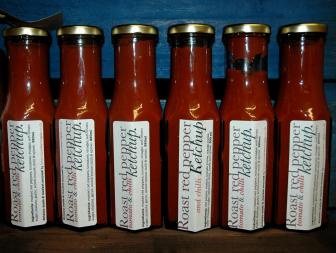
Roast red pepper ketchup from Cornercopia – I like spicy and yummy things, and this would appear to be both.”

Trip Stylist’s guided walks of London – because I like walking and I love London”

“The gorgeous Bettie Brazen bunting – because if we must celebrate the Diamond Jubilee, we could at least do it with style. ”

Cornercopia hamper – yay, they’ve already packed it!”